With the oceans covering greater than 70% of earth, IMAGINE if we could harness that vast, untapped force as a scalable, investable source of fresh water.
Investment Summary
Azura seeks A$8M deployment capital, not R&D, for a first-of-a-kind, at-sea desalination Reference Site.
Azura’s approach utilises its proven ocean energy technology transformed into a commercial at-sea desalination system that unlocks a pipeline of global projects.
Visionary investors participate via a dedicated project Trust, earning returns through project cash-flows, asset appreciation, and scalable revenue via licensing and direct sales.
The Problem
the need for freshwater is outpacing supply
Building a resilient, affordable water supply is no longer optional, it is a socioeconomic imperative.
Freshwater scarcity is accelerating worldwide. For example, the Australian Productivity Commission states, “the nation must enter a desalination building boom to avoid climate-driven economic damage that could exceed $700 billion by the end of the century” (The Age, 29 December 2025).
Azura's Solution
From Waves to Water
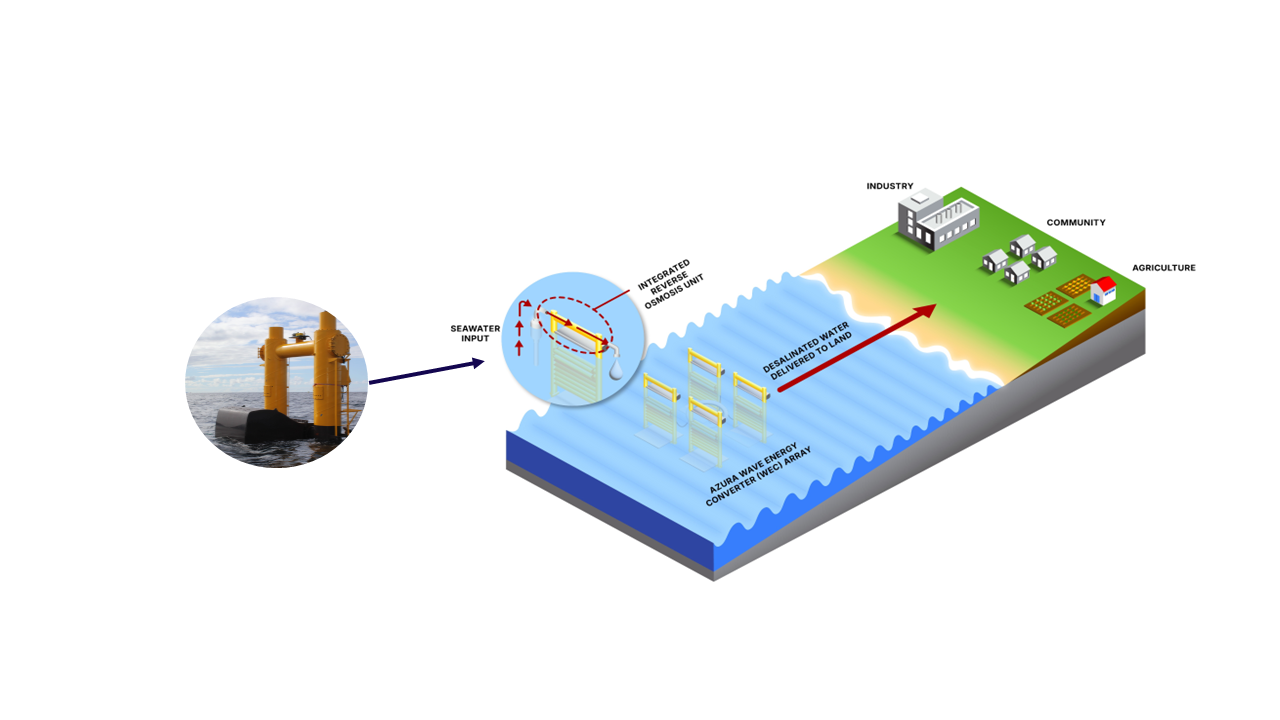
Azura’s proven wave energy converter (WEC) can produce fresh water at sea (“at-sea desalination”) by integrating a commercial Reverse Osmosis (RO) unit into the the power generator.
Similar to a car engine that converts fuel into motion, perpetual wave energy generates the power that drives the desalination process. Multiple wave energy devices can be connected to meet the customers water demand.
Projected growth: A$60B
by 2035 Small scale desal equals <1ML/day
0.15ML/day
Potential Production Capacity
Azura at-sea-desalination in arrays from 1-20+ units suitable for 0.15 to 3+ ML/day output
Up to 0%
Lower Levelised Cost of Water
Through lower grid electricity consumption (typically represents 30-50% of desal OPEX)
A$ 0M
Investment Target
Azura seeks A$8M deployment capital for an at-sea desalination Reference Site.
Growth Potential
Value Proposition – At-sea Desalination
Energy cost reduction
Energy is approximately 30-50% of desal operating costs. Wave energy is free and constant, providing more predictable long-term water costs and insulation from fuel and grid electricity price volatility.
Phased CAPEX exposure
Devices can be deployed incrementally as demand grows.
Environment
Brine is diluted and discharged offshore. Zero or near-zero carbon emissions from at-sea operations and no thermal pollution.
Cost avoidance
No additional large-scale, land-based water infrastructure is required or infrastructure expansion. At sea desalination will help reduce exposure to grid energy supply costs.
Energy independent
Operates entirely at sea, independent of coastal power grids.
Maintenance, operation and mobility
Modular system can be installed faster than traditional desalination plants, with remote monitoring and autonomous operations.
Go-to-Market Strategy
Azura’s commercialization strategy is anchored in a differentiated Reference Site approach, designed to unlock and accelerate a pipeline of projects while minimising execution risk.
The Reference Site system installation is a sales asset, designed to:
Validate performance, cost efficiency and scalability.
Validate environmental advantages, such as at-sea brine dispersion.
De-risk future projects for customers and capital partners.
Unlock a structured pipeline of international project opportunities, as illustrated.
Why Invest
De-risked Innovation
Azura’s Reference Site converts proven ocean energy technology into an at-sea desalination system, reducing first-of-a-kind risk and enhancing asset value.
Valuation increase
The Reference Site will be established as a specialized at-sea desalination Trust. The Trust’s valuation increases as technical and commercial risks are mitigated, assets are scaled, and the customer base grows.
Experienced Commercial Team & Governance
A seasoned delivery team drives growth, with investors participating at Trust level under strong governance aligned to value creation.
Scalable Revenue Model
Positioned in a high-growth market, revenues span direct sales, EPC delivery, licensing, and long-term water offtake agreements.
Get In Touch
call us
Stephanie Thornton —
General Manager
+64 22 504 5949