
At-sea

Desalination

Water security, powered by the sea

At-sea

Desalination

a wave-enabled desalination system

Why At-sea Desalination Matters

  • Water Scarcity: Desalination provides a lifeline for arid and drought-prone regions with limited freshwater sources.

  • Food production: can be limited by scarcity of freshwater.

  • Energy-Intensive: On-shore desalination plants traditionally require a lot of energy, but renewable-powered desalination is growing.

  • Environmental Concerns: The discharge of brine (highly concentrated salty water) back into the ocean can harm marine ecosystems if not managed properly.

How it works

Our proven wave energy converter (WEC) can produce fresh water at sea (“at-sea desalination”) by integrating a commercial Reverse Osmosis (RO) unit into the WEC. 

The Azura wave device captures the kinetic energy from waves and converts it directly into electrical power to drive the desalination process. Depending on the application, the system may include energy storage and smart controls to optimize operation around sea conditions and water demand.
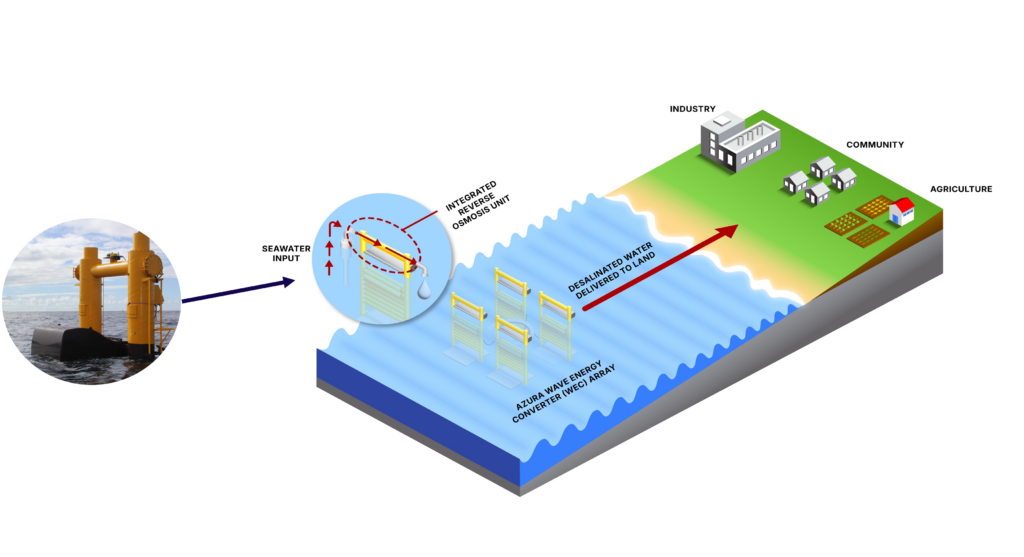
Fresh water is delivered to shore via:
  • Subsea pipelines for continuous pumped delivery to coastal communities, aquaculture sites, or agricultural operations.
  • Flexible hose systems for modular or temporary deployments.
  • Storage vessels transfer in remote or mobile configurations, where water is stored in onboard bladders and shipped to shore.

How it works

Our proven wave energy converter (WEC) can produce fresh water at sea (“at-sea desalination”) by integrating a commercial Reverse Osmosis (RO) unit into the WEC. 

The Azura wave device captures the kinetic energy from waves and converts it directly into electrical power to drive the desalination process. Depending on the application, the system may include energy storage and smart controls to optimize operation around sea conditions and water demand.

Fresh water is delivered to shore via:

  • Subsea pipelines for continuous pumped delivery to coastal communities, aquaculture sites, or agricultural operations.
  • Flexible hose systems for modular or temporary deployments.
  • Storage vessels transfer in remote or mobile configurations, where water is stored in onboard bladders and shipped to shore.

Technical Features

Customer Benefits from At-Sea Desalination

Low Cost

Energy Independent

Environment

Climate Change

Maintenance & Mobility

Key Markets

Asset 6

Desalination operators & Coastal water municipalities

Asset 64

Remote or island communities

Asset 4

Coastal agriculture: food production, livestock

Asset 9

Aquaculture: offshore operations, processing

Asset 3

Defence: emergency deployment

Asset 3

Oil/gas offshore operations